
Why Is My Cottage Pie Dry? Fixing the Filling and the Topping
By Michael
A dry cottage pie is the opposite problem to a watery one, but it is just as disappointing: gravy that has cooked away to almost nothing, or a topping like a plain slab of potato. Nearly every case comes down to one of the pie's two halves — the filling or the mash — and each half has its own causes and its own fixes.

First, work out which half is dry
Cut into the pie and judge the two halves separately. Spoon up some filling on its own: it should be moist and coated in gravy, falling off the spoon slowly. Then taste the mash on its own: it should be soft and buttery, not crumbly or pasty. In most disappointing pies, one half is fine and the other is the whole problem — and the fix for a filling that lost its gravy is completely different from the fix for a dry mash.
It also helps to rule out the opposite fault first. If the filling is swimming rather than dry, that is a different set of causes, covered in our guide to why a cottage pie turns out watery. This guide is about the pie that went the other way.
Why the filling dries out
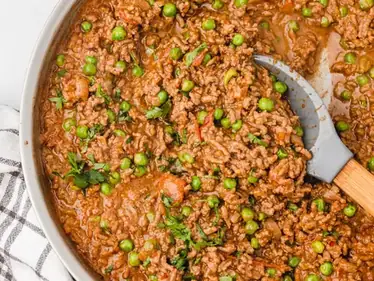
The gravy reduced too far. This is the commonest cause. The filling is meant to simmer until the gravy thickens and coats the mince — but keep it going past that point, especially at a lively simmer rather than a gentle one, and the liquid keeps reducing until there is barely any left. The mince ends up sitting in the pan almost dry, and no amount of baking will put that moisture back.
Too little stock to begin with. The tested recipe uses 400ml of hot beef stock for 500g of mince, and that quantity already allows for some reduction during simmering. Start with noticeably less, and by the time the vegetables are tender and the flour has done its thickening, the filling has nothing to spare.
Very lean mince, simmered for a long time. Lean mince has little fat in it, and fat is part of what makes a filling eat moist rather than dry and crumbly. A long simmer that a standard mince shrugs off can leave a very lean mince tasting parched, even when there is still some gravy in the pan.
A long, uncovered simmer. Leaving the lid off is sometimes done deliberately to thicken a loose filling — but it lets steam escape the whole time. Twenty extra uncovered minutes can take a filling from nicely coated to dry without anything else changing.
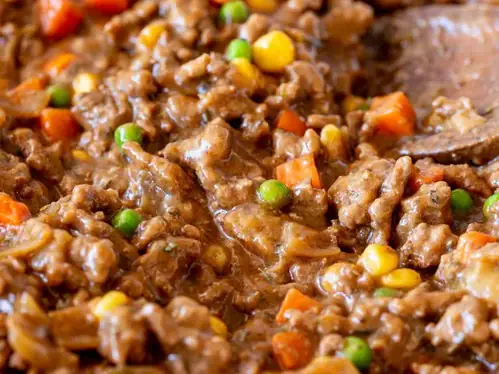
Fixing a dry filling
If the filling is still in the pan, the rescue is simple: stir hot beef stock back in, a splash at a time, and let it come back to a simmer between additions. Stop when the mince is coated in gravy that flows slowly off the spoon. A knob of butter stirred through at the end helps a filling made with lean mince taste richer and less dry.
The easiest moment to fix a dry filling is just before the mash goes on. Look at the filling in the dish: if it sits in stiff clumps with no loose gravy visible, stir a little hot stock through it there and then. Once the mash is on and the pie is baked, you can no longer adjust the filling itself — your only rescue is what you serve with it, which is covered below.
| Symptom | Likely cause | Fix |
|---|---|---|
| Filling clumps together and barely coats the spoon | Gravy reduced too far | Stir in hot stock a little at a time until it flows again |
| Gravy looks right, but the mince still tastes dry | Very lean mince | Stir a knob of butter through today's filling; use standard mince next time |
| Filling is loose at the edges but dry in the middle of the pan | Simmered uncovered for too long | Replace the lost liquid with hot stock; simmer with the lid ajar next time |
| Mash is crumbly and pale | Mash made with too little butter or milk | Next time use the full 50g butter and about 75ml milk per 900g potatoes; dot extra butter over today's top before baking |
| Top is hard and dark while the middle is fine | Pie baked too long | Keep to 25 to 30 minutes; if the top colours early, cover loosely with foil |
| Whole pie dry the next day | Reheated for too long | Reheat only once, covered, until steaming hot all the way through — and serve with gravy |
Why the topping dries out
The mash was made dry. Mash with too little butter or milk starts dry and stays dry. In the tested recipe, 900g of potatoes take 50g of butter and about 75ml of warm milk, and that balance matters: cut the butter right back or splash in only a token amount of milk, and the topping comes out crumbly, pale and reluctant to spread. Potatoes left steaming in the colander for a long time before mashing also give up moisture they could have kept.
The pie was baked too long. The bake is there to heat the pie through and colour the top — in the tested recipe, 25 to 30 minutes at 200°C (180°C fan, Gas Mark 6). Stretch that by another twenty minutes and the oven keeps drying the topping the whole time: the ridges harden, the surface tightens, and the mash just under the crust turns floury.
Leftovers were reheated too hard. A portion of pie has already been baked once. Reheat it uncovered at a high temperature for a long time and the topping takes the punishment — it is the part facing the heat. This is why yesterday's pie so often disappoints even when it was perfect the night before.
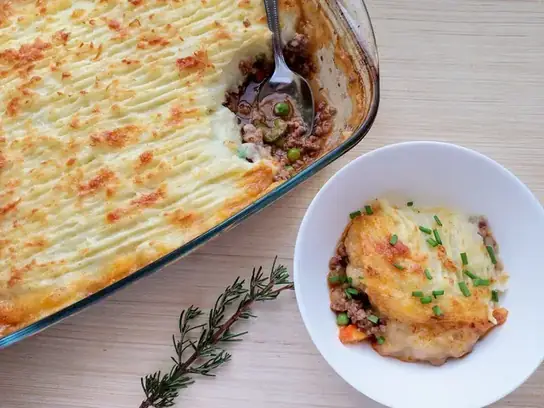
Fixing a dry topping
Before the pie goes in the oven, you still have options. If the mash looks stiff in the pan, warm a little more milk and beat it in — a tablespoon at a time — until the mash spreads willingly. Once it is on the pie, dot small knobs of butter over the surface and rough it up with a fork: the butter melts into the ridges as it bakes and keeps the top from drying into a hard crust.
During the bake, watch the colour rather than the clock alone. If the top is browning well before the time is up, lay a sheet of foil loosely over the dish for the remaining minutes. The pie keeps heating through, but the topping stops losing moisture to the full force of the oven.
Rescuing a pie that is already dry
Sometimes you only find out at the table. The honest position is that a baked pie cannot be un-dried — but it can be served in a way that makes the dryness barely matter. A jug of hot gravy on the table is the classic rescue, and it works: spooned over each portion, it replaces the moisture the filling lost. Our cottage pie gravy guide covers making a proper extra gravy for exactly this situation.
Two smaller things help as well. Rest the pie for 5 to 10 minutes before serving, as the tested recipe does — the filling settles and what gravy there is redistributes instead of running out of the first slice. And serve the pie with something moist alongside, such as peas or carrots with a knob of butter melted over them, rather than anything else dry.
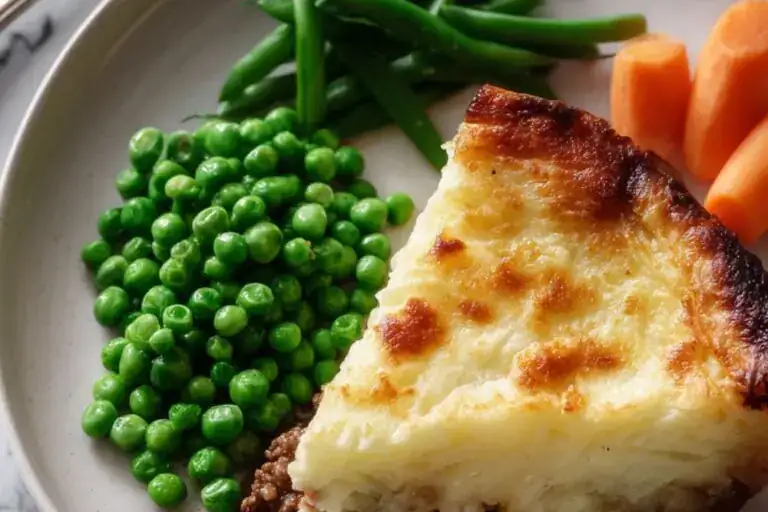
The balance in the tested recipe
Most of these faults are a departure from a balance that already works, so it is worth knowing what that balance is. In our cottage pie recipe — the one recipe on this site that has been kitchen tested exactly as written — 500g of beef mince simmers in 400ml of hot beef stock, which reduces to a gravy that coats rather than pools. The mash uses the full 50g of butter and about 75ml of warm milk to 900g of potatoes. The pie bakes for 25 to 30 minutes, long enough to heat through and colour, and rests for 5 to 10 minutes before serving.
If your pies keep coming out dry, compare your method against those three points — stock quantity, mash quantities, baking time — before changing anything else. In our experience of the ways this pie goes wrong, the cause is nearly always one of them.
Questions people ask
A little extra is fine — an additional splash, say 50ml, gives the filling more room to reduce without drying. But a lot of extra stock does not make a moister pie; it makes a looser one that then needs longer simmering to thicken, which can dry the mince out anyway. Add modestly, and judge by how the finished filling coats the spoon.
Not bad, but less forgiving. With little fat of its own, lean mince tastes dry much sooner if the filling is simmered hard or for a long time. If you prefer lean mince, simmer gently, keep the lid ajar rather than off, and stir a knob of butter through the finished filling — it makes a real difference to how moist it eats.
Not by itself. Cracks and deep fork ridges are normal on a baked pie, and the raised edges are the parts that brown and crisp — many people like them best. A dry topping is about the texture underneath: crumbly, pale and floury rather than soft. Judge the mash by tasting a spoonful from the middle of the pie, not by the cracks on the surface.
Not from the start — the top needs direct heat to colour. Foil is a rescue, not a routine: lay it loosely over the dish if the top has browned well but the pie needs its full time to heat through, or when reheating a portion, when the topping has already had one bake and dries out quickly.
Cover the portion or dish with foil and reheat gently until it is steaming hot all the way through, with the centre at least 75°C. Reheat leftovers only once. Fridge the pie promptly too: cool it and refrigerate within 1 to 2 hours, keep the fridge between 0 and 5°C, and eat leftovers within 2 days. A spoonful of gravy over the top when serving covers any dryness that remains.
Not completely — you cannot put moisture back into an over-baked topping or an over-reduced filling once the pie is assembled. What you can do is serve it well: rest it for 5 to 10 minutes, then put a jug of hot gravy on the table and spoon it generously over each portion. It does not change the pie, but it changes the eating, and most of the dryness stops mattering.