Gluten-Free Cottage Pie with Beef Mince and Mash
By Michael
Cottage pie is closer to gluten-free than most people expect. In our tested recipe, exactly one ingredient contains gluten — a single tablespoon of plain flour — and everything else is naturally gluten-free. This guide covers the swap, the label checks that still matter, and the kitchen habits that keep gluten out of the finished pie.
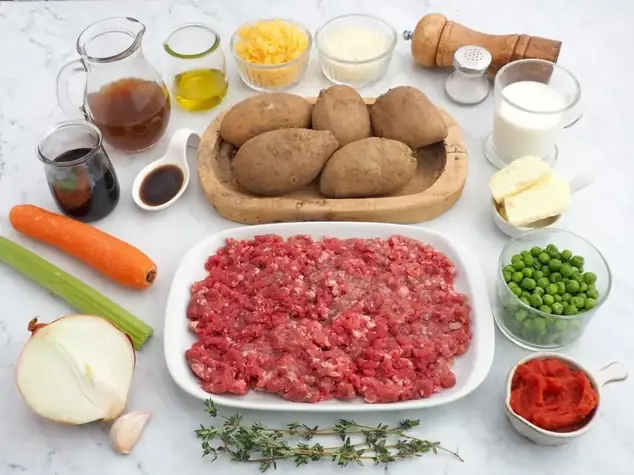
Only one ingredient in the tested recipe contains gluten
Work through the filling of the tested recipe and the picture is reassuring. Beef mince, onion, carrots, celery, garlic, tomato purée, dried thyme, a bay leaf and frozen peas are all naturally gluten-free. So is the whole of the mash: floury potatoes, butter and milk contain no gluten. The single exception is the 1 tablespoon of plain flour, sprinkled over the softened vegetables to thicken the gravy as the filling simmers.
That one tablespoon is doing a real job, though. Without a thickener, 400ml of beef stock gives you a loose, soupy filling that soaks into the mash. So the answer is not to leave the flour out and hope — it is to thicken the gravy a different way, which is where cornflour comes in.
Two more ingredients sit in a grey area rather than the clear one. Beef stock and Worcestershire sauce are usually fine, but "usually" is not good enough when someone at the table cannot eat gluten. Some stock products use wheat-based ingredients, and Worcestershire sauce formulations vary between makers and can change over time. Neither point is a reason to avoid them — both are covered by the label checks in the table below.
How to thicken with cornflour instead of flour
Flour and cornflour thicken in different ways, and the method changes slightly to match. In the tested recipe, the flour is sprinkled over the vegetables and cooked in the pan juices for a minute before the stock goes in. It then thickens gradually during the simmer, and the early cooking in fat takes away any raw taste.
Cornflour cannot be used that way. Tipped dry into a hot pan it clumps instantly, and no amount of stirring rescues the lumps. Instead, mix the cornflour to a smooth paste first: put 1 tablespoon of cornflour in a small cup, add about 2 tablespoons of cold water, and stir until there are no dry pockets left. Cold water is essential — hot water cooks the outside of each grain and seals the lumps in.
Then follow the filling exactly as written, skipping the flour. Soften the onion, carrots and celery, add the garlic, stir in the tomato purée and Worcestershire sauce, and pour in the hot beef stock. Bring the pan to a gentle simmer and stir the cornflour paste in, a little at a time, stirring as you go. The gravy thickens as it simmers: give it a minute or two, until it coats the back of a spoon (estimate). If it looks thin, wait before adding more — cornflour reaches its full thickness at simmering point, and it is easy to overshoot.
Two honest differences to expect. The gravy looks slightly glossier with cornflour than with flour, because cornflour sets clear rather than cloudy. And cornflour does not love a long, hard boil: boiled fiercely for a long time it can start to thin again. Stir it in once the filling is simmering, keep the heat gentle, and shorten the final simmer if you need to — the vegetables and mince are already cooked by that stage.
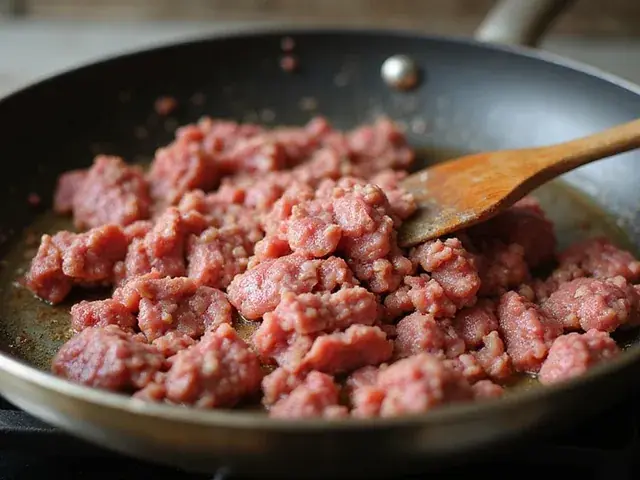
Where gluten can hide in cottage pie
The flour is the obvious source, but it is not the only one worth a thought. This table covers the ingredients in and around the recipe where gluten can turn up without being obvious.
| Ingredient | Risk | What to do |
|---|---|---|
| Plain flour | Contains gluten — it is the one definite source in the recipe | Replace with cornflour, used as a cold-water paste as described above |
| Beef stock | Some cubes, pots and powders use wheat-based ingredients or thickeners | Check the ingredients and allergen information on the label; choose one that states it is gluten-free |
| Worcestershire sauce | Formulations vary between makers; some are made with malt vinegar, which comes from barley | Read the label on the bottle you actually have, every time — recipes and formulations change |
| Gravy granules | Not in the tested recipe, but a common shortcut; many brands are thickened with wheat flour | Skip them, or use only a product clearly labelled gluten-free |
| English mustard | An optional extra in the mash; mustard is naturally gluten-free, but blends and prepared mustards vary | Check the label as you would for stock; mustard is also an allergen in its own right |
The habit to build is simple: the label on the product in your hand beats any list, including this one. Manufacturers change recipes without changing the front of the packaging, so a product that was fine last year deserves a fresh look at the allergen information this year.
The method, with the one change in place
Here is the full pie in order, so you can cook from this page. Quantities, timings and temperatures are the tested ones; the only change is flagged where it happens. The pie serves four.
- Brown the mince. Heat 1 tablespoon of oil in a large pan and cook 500g of beef mince until browned all over, breaking up any clumps. Tip it onto a plate.
- Soften the vegetables. In the same pan, cook 1 large finely chopped onion, 2 finely diced carrots (about 200g) and 2 chopped celery sticks until softening. Stir in 2 crushed garlic cloves.
- Skip the flour. This is the change: where the tested recipe sprinkles over 1 tablespoon of plain flour, add nothing here. Stir in 2 tablespoons of tomato purée and 1 tablespoon of Worcestershire sauce (label checked), then pour in 400ml of hot beef stock (label checked). Add 1 teaspoon of dried thyme and a bay leaf.
- Thicken with the cornflour paste. Bring the filling to a gentle simmer. Stir the cornflour paste — 1 tablespoon of cornflour mixed with about 2 tablespoons of cold water — into the pan a little at a time. Simmer gently for a minute or two until the gravy thickens and coats a spoon (estimate). Stir in 100g of frozen peas, simmer briefly, remove the bay leaf, and season with salt and black pepper.
- Make the mash. Boil 900g of peeled, chunked floury potatoes (Maris Piper or King Edward) until tender. Drain well, then mash with 50g of butter and about 75ml of warm milk, and season.
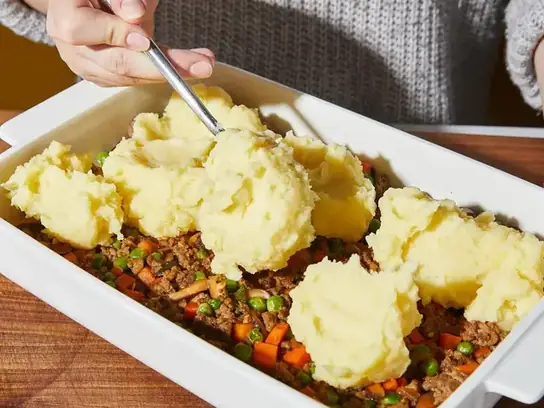
- Assemble. Spoon the filling into an oven dish of about 2.5 to 3 litres, roughly 20 × 30 cm. Dollop the mash over the top, spread it to the edges so the filling is sealed in, and ridge the surface with a fork.
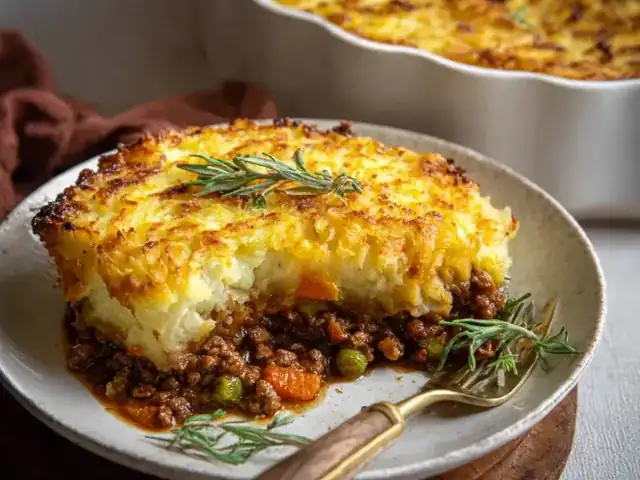
- Bake. Cook at 200°C conventional / 180°C fan / Gas Mark 6 for 25 to 30 minutes, until the top is golden and the filling is bubbling at the edges. Rest the pie for 5 to 10 minutes before serving, so the gravy settles.
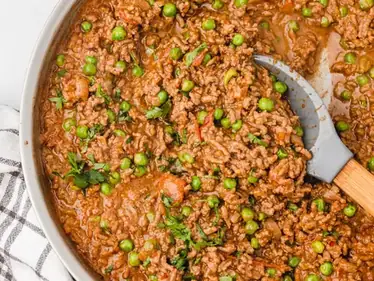
Keeping gluten out of the rest of the kitchen
If the pie must be strictly gluten-free, the ingredients are only half the story. The other half is what touches the food on its way to the dish. None of this needs special equipment — it is ordinary care, applied consistently.
Start with clean surfaces and tools. A chopping board and knife used for bread carry crumbs; wash them, or use clean ones, before they go near the pie ingredients. The same goes for the spoon you stir with and the colander you drain the potatoes in, if either has just been used for pasta.
Butter deserves a specific mention. A shared butter dish picks up crumbs from every knife that has spread toast. For the mash, cut a fresh portion from a new block, or take butter from a part of the dish no knife has visited. It is a small thing, and it is exactly the sort of small thing that undoes careful shopping.
Keep wheat flour out of the work area while you cook. Flour dust settles. If someone else is baking in the same kitchen, make the pie first, or in a clear space, and store the cornflour and other ingredients for the pie away from the flour bag, in closed containers. Finally, serve the pie with a clean spoon that has not been used on anything else.
The mash and the optional extras
The mash needs no changes at all. Potatoes, butter and milk are naturally gluten-free, and the method — boil, drain, mash with warm milk — is the tested one. A floury variety such as Maris Piper or King Edward gives the light, fluffy top that crisps in ridges in the oven.
The three optional extras in the recipe are worth a sentence each. The 50g of mature Cheddar scattered over the top: cheese is naturally gluten-free, though checking the label costs nothing. The pinch of grated nutmeg: a plain spice, no issue. The teaspoon of English mustard stirred into the mash: as the table above notes, check the label on the jar or tin you have, because prepared mustards vary and mustard is itself an allergen. If anything cannot be verified, leave it out — all three are optional, and the pie does not depend on any of them.
Cooking for someone with coeliac disease
One boundary is worth stating plainly. This page is a recipe adaptation, written for home cooks. It is not medical advice, and it cannot replace guidance written for people with coeliac disease. If you are cooking for someone with the condition, follow Coeliac UK's guidance on ingredients, labelling and avoiding cross-contamination, and the advice of their own clinician. When in doubt about a product, leave it out or choose one certified gluten-free — nobody at the table minds a plainer pie that is a safe pie.
Questions people ask
No, but it is close. In our tested recipe the only ingredient containing gluten is 1 tablespoon of plain flour used to thicken the gravy. The mince, vegetables, potatoes, butter and milk are all naturally gluten-free. Swap the flour for cornflour, check the labels on the stock and Worcestershire sauce, and the pie is gluten-free.
Use the same amount: 1 tablespoon of cornflour for the 1 tablespoon of plain flour. Mix it to a smooth paste with about 2 tablespoons of cold water, then stir it into the filling once the stock is simmering. Add it gradually and give it a minute or two to reach full thickness before deciding whether it needs more (estimate).
It depends on the bottle. Formulations vary between makers, and some Worcestershire sauces are made with malt vinegar, which is derived from barley. There is no safe general answer, which is why the rule on this page is to read the allergen information on the label of the sauce you actually have, every time you buy it.
Some are and some are not. Certain stock cubes, pots and powders include wheat-based ingredients or thickeners, while others are made and labelled gluten-free. Check the ingredients list and allergen information on the packaging, and choose a product that clearly states it is gluten-free if the pie must be strictly so.
A plain gluten-free flour blend can be sprinkled over the vegetables and cooked in the pan juices in exactly the same way as the wheat flour in the tested recipe, so it is the closer like-for-like swap in method. We have not tested it in this recipe, so we cannot promise the same result; the cornflour method described on this page is the one we set out in full. Either way, the blend must be a plain one, not self-raising.
Gravy granules are not part of the tested recipe, and many standard brands are thickened with wheat flour, so they would put the gluten straight back in. If you want to use them, choose a product clearly labelled gluten-free and check the allergen information. The cornflour paste does the same job with an ingredient you may already have in the cupboard.
For the outline version of this swap, see the gluten-free section of our cottage pie variations. When you are ready to cook, work from the tested cottage pie recipe and make the single change described here: cornflour paste in, plain flour out, labels checked.