
Can You Make Cottage Pie Ahead?
By Michael
Cottage pie suits being made ahead better than most family dinners. You can stop at the filling, stop at the assembled pie, bake it completely, or freeze it for another week. This guide compares the four routes, gives the safe limits for each, and ends with a worked schedule for a Sunday lunch.
Why this pie makes ahead well
Some dishes resent being cooked twice. Cottage pie is not one of them. The filling is a braise in gravy, and braises reheat evenly and often taste better the next day, once the flavours have settled into each other.
The topping is forgiving too. Mashed potato can be made fresh on the day, or spread over the filling a day early and baked from chilled. Either way it emerges golden and crisp-ridged, because the oven does the finishing work at the end.
Every route below starts from the same pie. Our cottage pie recipe serves four, was kitchen-tested by the site owner, and uses 500g of beef mince, 400ml of beef stock and 900g of floury potatoes in a dish of about 2.5 to 3 litres. Making it ahead changes only when you cook, never what you cook.
The four routes at a glance
| Route | How far ahead | What you do on the day | Texture notes |
|---|---|---|---|
| Filling only | Up to 2 days | Make the mash, assemble and bake | Freshest mash; filling flavour deepens slightly |
| Assembled, unbaked | The day before | Bake from chilled, with longer in the oven | Layers stay distinct if assembled cold |
| Fully baked | Up to 2 days | Reheat until steaming hot throughout | Topping softens a little, then catches again |
| Frozen | Weeks ahead | Defrost in the fridge, then bake or reheat | Mash can weep slightly; still good family food |
Route 1: make the filling only
The filling is the easiest part to cook early. Brown the 500g of beef mince, soften the onion, carrot and celery, and build the gravy with the 400ml of beef stock, exactly as the recipe sets out. If you like, hold the peas back; they keep their colour better when they go in later.
Cool the filling as quickly as you can and refrigerate it within 1 to 2 hours. Keep the fridge between 0 and 5°C. A wide, shallow container cools faster than a deep one, so spread the filling out rather than leaving it in the cooking pan.
Understand what the cooked filling becomes: leftovers. Food Standards Agency guidance is to eat leftovers within 2 days. So a filling made on Saturday suits a Sunday or Monday pie, but not one planned for Wednesday.
On the day, warm the filling gently on the hob until it bubbles, and stir in the peas if you held them back. Top it with freshly made mash and bake for 25 to 30 minutes at 200°C conventional, 180°C fan, Gas Mark 6. Hot filling with fresh mash is the closest result to a pie made in one go. Treat that bake as the filling's one reheat, and do not reheat any leftovers from the finished pie again.
Route 2: assemble the whole pie, unbaked
This route saves the most work on the day. Cook the filling and let it cool completely, then refrigerate it. Make the mash and let that cool too. Only then assemble the pie, cold layer on cold layer.
Cold filling and cold mash matter. Warm mash spread over warm filling slumps, and the layers bleed into each other as they sit. Cold layers stay distinct, so the finished pie holds its shape when you serve it. Seal the mash to the edges of the dish and ridge it with a fork, exactly as you would for a fresh pie. Cover the dish and put it straight back into the fridge.
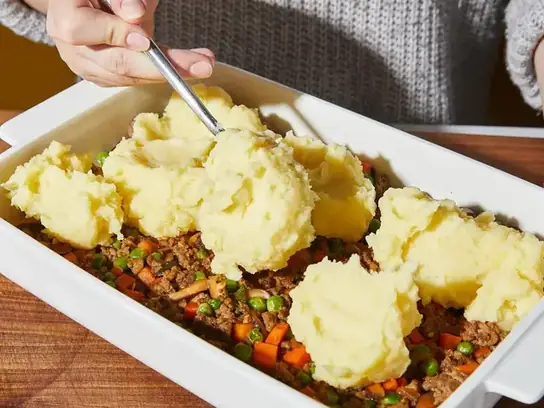
Use the assembled pie within 2 days of the day you cooked the filling. The filling's clock is the one that counts, not the day you assembled it.
Bake the pie from chilled, never after a rest on the worktop. A cold pie needs longer than the 25 to 30 minutes a hot-filled pie takes at 200°C conventional, 180°C fan, Gas Mark 6. Allow about 40 to 50 minutes (estimate). Check the centre before serving: a food probe should read at least 75°C, or you should see steam rising and the filling bubbling at the centre when you cut in. Rest the pie for 5 to 10 minutes before serving.
Route 3: bake it fully, then reheat
Bake the pie completely, following the recipe to the end. Cool it within 1 to 2 hours, cover it and refrigerate it. Eat it within 2 days, like any other leftovers.
Reheating a whole baked pie needs care, because the centre must end up steaming hot throughout — and a cooked pie should be reheated only once. Our guide to how to reheat cottage pie covers oven settings, timings and the centre check in detail.
The topping will not be quite as crisp as on a freshly baked pie. The ridges do catch again in a hot oven, though, and the filling often tastes better for its rest. Of the three fridge routes, this is the one to choose when the day itself leaves you almost no time at all.
Route 4: freeze it
Freezing is the right route when "ahead" means more than a couple of days. Freeze the pie assembled and unbaked, or fully baked and cooled. Both work well, and both free you from the 2-day clock entirely.
Defrost the pie in the fridge, never on the worktop. Once it has defrosted, cook and eat it within 24 hours. Wrapping, containers and defrosting times are covered in our guide to freezing cottage pie.
A frozen pie is the lowest-pressure option of the four. Nothing about it runs to a schedule until the day before you eat it, when it moves from freezer to fridge.
A worked schedule: Sunday lunch
Here is the assembled route planned out for a Sunday lunch. The pattern fits any day of the week. Shop first, filling next, assembly last, and baking on the day itself.
| Stage | When | Task |
|---|---|---|
| Shopping | Friday | Buy the mince, potatoes and vegetables; check stock, plain flour and tomato purée |
| Filling | Saturday morning | Cook the filling; cool it within 1 to 2 hours; refrigerate |
| Mash and assembly | Saturday afternoon | Make the mash, let it cool, assemble the cold pie, cover and refrigerate |
| Baking | Sunday, about an hour before lunch | Bake from chilled for about 40 to 50 minutes (estimate); check the centre; rest 5 to 10 minutes |
Notice what the schedule avoids. Nothing is cooked twice in one day, nothing hot is left standing around, and Sunday's work is one dish going into the oven. While the pie bakes and rests, there is time to cook the vegetables and lay the table.
Fridge space and dish notes
The dish does the storing as well as the baking. The recipe's dish, about 2.5 to 3 litres, goes from fridge to oven happily if it is ovenproof glass, ceramic or metal. For a chilled ceramic dish, follow the maker's guidance; standing the cold dish on a preheated baking tray softens the sudden change in temperature.
Fridge space is the quiet constraint. A full-size pie dish takes up most of a shelf in many fridges, so clear the space before you start cooking, not after. Keep the covered pie on its own shelf area, away from raw meat.
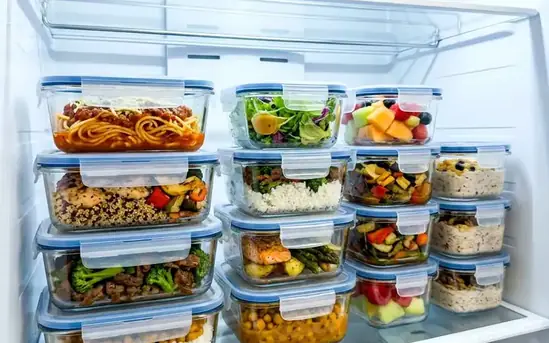
If space is tight, the filling-only route stores far smaller. A lidded container of filling tucks into a corner, and the potatoes wait in their bag until the day. Choosing between routes is often really a decision about the fridge, not about the cooking.
What not to do
Do not leave an assembled pie standing at room temperature. Not overnight, not just for the morning, and not in a cool pantry or garage. Cooked filling and cooked mash belong in the fridge, and the 1 to 2 hour cooling window is the longest the uncovered pie should spend out of it before baking.
Do not make the mash days ahead on its own. Kept alone in the fridge, mashed potato slowly turns grey and watery, and the butter flavour fades. Mash made on the day — or mash assembled onto the pie the day before — holds up far better than mash waiting in a bowl.
Do not assemble a pie over hot filling unless you are baking it straight away. A warm assembled pie left sitting is the worst of both worlds: the layers slump into each other, and the pie spends too long at room temperature. Assemble cold, or assemble and bake at once.
Questions people ask
Two days, for anything already cooked. The filling, the assembled pie and the baked pie all follow the same leftovers rule: refrigerate within 1 to 2 hours and eat within 2 days. Beyond that, freeze the pie instead. Freezing pauses the clock until you defrost it.
On the same day, yes: make it in the morning, cover it, refrigerate it, and spread it over the filling later. Days ahead, no — mash kept alone turns grey and watery. If you need the topping done a day early, assemble the whole pie instead. The mash keeps far better on the pie than in a bowl.
Only if it sits uncovered. Cover the dish well and the mash stays moist. The top will look pale and flat when the pie goes into the oven, but the ridges firm up and take colour as it bakes. If the surface looks very dry, dot it with a little butter before baking.
Bake from chilled. Leaving a cooked-filling pie on the worktop to warm up keeps it at room temperature for no benefit. A chilled pie simply needs longer in the oven: about 40 to 50 minutes (estimate) at 200°C conventional, 180°C fan, Gas Mark 6. Check the centre reaches at least 75°C on a probe, or is steaming and bubbling, before serving.
Yes, and it is a sensible way to freeze it. A foil tray frees up your oven dish, moves from freezer to fridge for defrosting, and can go straight into the oven afterwards. See our guide to freezing cottage pie for tray sizes, wrapping and defrosting times.
Whichever route you pick, the work is identical — only the timing moves around. Start with the cottage pie recipe, choose the route that fits your week, and when the pie goes into the oven, our guide to what to serve with cottage pie covers the rest of the plate.