
Cottage Pie for Two: Quantities for a Smaller Dish
By Michael
Halving a recipe can feel like guesswork. For this pie it is mostly arithmetic. Every quantity divides by two, the method does not change, and the only real decisions left are the dish and a slightly shorter bake.
These quantities are exact halves of our cottage pie recipe, which serves four and was kitchen-tested, cooked exactly as written. The two-serving version has not been kitchen-tested separately. The ingredients below are simple arithmetic; the shorter baking time is an estimate, so rely on the doneness cues rather than the clock alone.
The quantities, halved
Almost everything divides cleanly. The one exception is the bay leaf: a whole leaf still goes in, because half a leaf is a fiddly thing that seasons nothing properly. Use a small leaf if you have one, and take it out before serving, as usual.
| Ingredient | Serves 4 | Serves 2 |
|---|---|---|
| Beef mince | 500g | 250g |
| Sunflower or vegetable oil | 1 tbsp | 2 tsp |
| Onion | 1 large | 1 small, or half a large |
| Carrots | 2 (about 200g) | 1 (about 100g) |
| Celery | 2 sticks | 1 stick |
| Garlic | 2 cloves | 1 clove |
| Plain flour | 1 tbsp | 1½ tsp |
| Tomato purée | 2 tbsp | 1 tbsp |
| Worcestershire sauce | 1 tbsp | 1½ tsp |
| Hot beef stock | 400ml | 200ml |
| Dried thyme | 1 tsp | ½ tsp |
| Bay leaf | 1 | 1 (it does not halve) |
| Frozen peas | 100g | 50g |
| Floury potatoes | 900g | 450g |
| Butter | 50g | 25g |
| Warm milk | About 75ml | About 40ml |
| Mature Cheddar (optional) | 50g | 25g |
The milk is marked "about" in the original recipe too. Add it gradually and stop when the mash is soft enough to spread; smaller batches of mash can turn wet quickly if the full amount goes in at once.
The method does not change
Follow the main recipe step for step. Brown the mince in hot oil, soften the onion, carrot and celery, add the garlic, flour and tomato purée, then the stock, thyme and bay leaf. Simmer until the gravy coats the back of a spoon, and stir in the peas. Boil the potatoes, mash them with the butter and warm milk, then assemble and bake.
The potatoes need the same care in miniature. Cut the 450g into even chunks and they will be tender a few minutes sooner than the full batch, so test them with a knife rather than trusting the clock. Drain them well and let the steam escape for a minute before mashing: a small batch turns wet quickly.
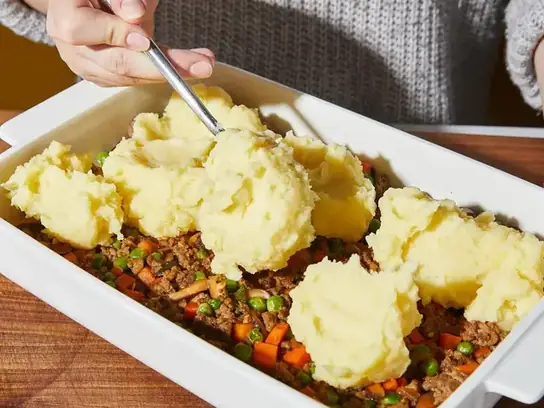
Two watch-points are worth knowing. First, browning 250g of mince is quicker than browning 500g. It colours faster and needs less time in the pan, so keep it moving and take it off the heat as soon as it is browned all over.
Second, a smaller filling reduces faster. There is half the stock in much the same pan, so the gravy thickens sooner and can catch on the base. Keep the simmer gentle, stir now and then, and loosen it with a splash of hot stock if it tightens too far.
Choosing the dish
Use a dish of about 1.2 to 1.5 litres, roughly 18 to 20 cm across. In a dish that size the filling sits about 2.5 cm deep — the same depth as in the full-size pie. Depth is what makes the bake behave the same way, so it is worth matching even though the pie is smaller. Any ovenproof dish of that size is suitable: ceramic, glass or metal all work.
Two individual dishes work just as well as one shared dish. Use two ovenproof dishes or deep ramekins of roughly 600 to 750ml each, and divide the filling and the mash between them. Individual pies freeze one at a time without waste, and each person gets a full ring of crisped edge.
This batch size has a second advantage: it is the size that fits most air fryers. If you would rather finish the pie that way, our air fryer cottage pie guide covers dish fit, temperature and the centre check that matters with that method.
Baking the smaller pie
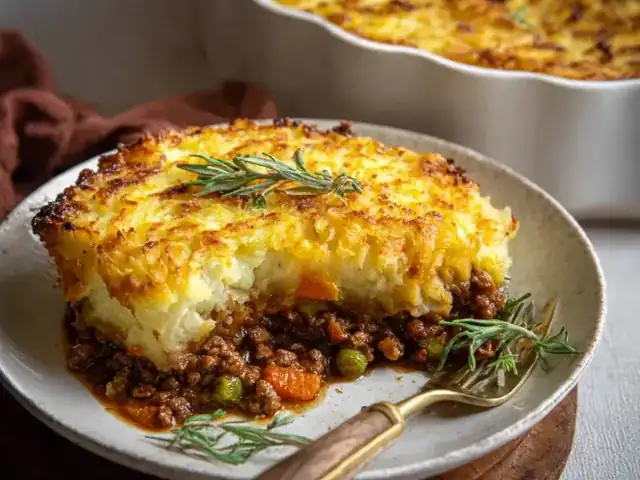
The oven settings do not change: 200°C conventional, 180°C fan, Gas Mark 6. A smaller pie simply needs a little less time. About 20 to 25 minutes is a reasonable estimate, against the 25 to 30 minutes of the full-size pie — treat it as a guide and check the cues below.
The doneness cues do not shrink with the pie. Bake until the filling bubbles at the edges and the forked ridges are golden. The centre must be piping hot: a probe pushed into the middle reads at least 75°C, or the filling steams and bubbles when you cut into it. Rest the pie for 5 to 10 minutes before serving, as with the full size.
The scaler on the recipe page
The recipe page has a serving scaler for 2, 4, 6 and 8 servings. Set it to two and it adjusts every ingredient quantity for you — the same halves as the table above, without the arithmetic. It is the quickest way to get the quantities right.
What the scaler cannot do is advise on the dish or the clock. It changes quantities only, not dish size or baking time. The dish guidance and the shorter bake in this post are the other half of the job. The table above earns its place when you are shopping or cooking from a printed copy; the scaler is quickest when you already have the recipe page open.
Leftovers from a pie for two
A smaller pie makes smaller leftovers, but the rules are identical to the full-size version. Cool the pie as quickly as you can, keep it in a fridge between 0 and 5°C, and eat it within 2 days. Reheat once only, until steaming hot all the way through, and check the centre rather than the edges before serving. Do not reheat the same portion twice. The full storage guidance is in our FAQs, following Food Standards Agency advice.
Questions people ask
No — use a whole leaf, ideally a small one. A bay leaf seasons the gravy gently as it simmers, and half a leaf is awkward to handle and easy to lose in the filling. Keep the whole leaf, let it do its work, and fish it out before the mash goes on or before serving.
Yes. Assemble the full half batch, then split it: bake one portion now in a small dish and freeze the other unbaked in its own dish or a suitable container. Defrost it in the fridge before baking, then bake as above until the centre is piping hot. Freezing and defrosting times are covered in our FAQs.
The pie will sit shallower, and a shallow pie bakes faster and dries out sooner. You can still make it, but check it early — it may need less than the estimated time — and expect a thinner layer of filling under the mash. A smaller dish is the better fix: the depth is what keeps the bake predictable.
Yes. The scaler on the recipe page covers 6 and 8 servings as well as 2 and 4, and adjusts the quantities for you. The dish must grow with the batch: for eight servings you need a dish of about 5 to 6 litres, so the filling keeps a similar depth and the bake behaves as expected.
Because evaporation works proportionally harder on a small batch. Half the stock sits in much the same pan, over much the same heat, so a larger share of it boils away before the flour has finished thickening the rest. Keep the simmer gentle and add a splash of hot stock at the end if the gravy has tightened too far.
Half the quantities, the same method, a dish of the right depth — that is the whole job. The quantities sit alongside the kitchen-tested cottage pie recipe, and the same half batch is the one to use for air fryer cottage pie.