
Slow Cooker Cottage Pie with an Oven-Finished Mash Topping
By Michael
The filling cooks low and slow while you get on with the day, and the mash is made fresh at the end. Then the assembled pie goes into a hot oven for the golden, crisp top that a slow cooker cannot produce. All the flavour of the original, with the long cooking done for you.
An honesty note before you start: this is an adaptation of our cottage pie recipe, which was kitchen-tested with beef. The slow cooker version has not been kitchen-tested separately. The ingredients and the oven finish follow the tested recipe; every slow cooker time below is marked as an estimate.
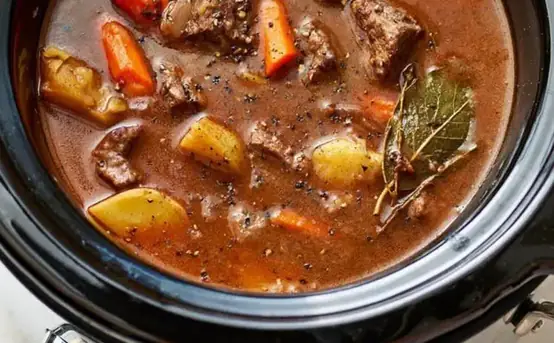
Why the oven finish is not optional
A slow cooker cooks gently, under a tight lid, in its own steam. Nothing inside it can brown. There is no dry heat and no high surface temperature, and browning needs both.
Spread mash over the filling inside the cooker and it will cook through — but it stays pale, soft and damp. Left long enough, it can also drink up liquid from the filling and slump into it. You end up with a stew wearing a wet hat, not a pie.
The oven finish is short because the filling is already cooked and hot. Those 25 to 30 minutes exist to crisp and colour the topping and bring the pie together. It is the same bake, at the same settings, as the tested recipe.
Assemble the pie while the filling is hot, and bake it straight away. A warmed oven dish helps: stand it in hot water in the sink while you make the mash. Spooning hot filling into a stone-cold dish steals heat that the bake then has to replace, and the centre takes longer to come back to piping hot.
The ingredients
The ingredients are the tested recipe's, unchanged, with a single exception. The stock drops from 400ml to 300ml. A slow cooker loses almost no liquid — the lid traps it all — while the vegetables give out moisture of their own. Keep the full 400ml and the gravy finishes thin.
For the filling:
- 1 tbsp sunflower or vegetable oil
- 500g beef mince
- 1 large onion, finely chopped
- 2 carrots, finely diced (about 200g)
- 2 celery sticks, finely chopped
- 2 garlic cloves, crushed or finely chopped
- 1 tbsp plain flour
- 2 tbsp tomato purée
- 1 tbsp Worcestershire sauce
- 300ml hot beef stock (reduced from the tested recipe's 400ml)
- 1 tsp dried thyme
- 1 bay leaf
- 100g frozen peas
- Salt and black pepper
For the mash:
- 900g floury potatoes, such as Maris Piper or King Edward
- 50g butter
- About 75ml warm milk
- Salt and black pepper
The filling serves four, exactly as tested. Use a slow cooker that holds it no more than about two-thirds full, and an ovenproof dish of about 2.5 to 3 litres for the assembly.
Preparing ahead
The browning stage can be done the evening before. Brown the mince, soften the vegetables and stir in the flour and tomato purée, following steps 1 to 3 below. Then cool the mixture quickly, cover it and put it in the fridge. In the morning, tip it into the cooker and pour over the hot stock — hot, so the cooker is never asked to warm a cold, dense mixture from scratch — and cook as described.
The method
- Heat the oil in a large frying pan over a high heat. Brown the mince in batches until well coloured all over, then lift it into the slow cooker. Browning first is part of this method: it builds flavour the long cook cannot create, and it starts the cooking safely — do not put raw mince straight into the cooker.
- Turn the heat down. Soften the onion, carrots and celery in the same pan for about 10 minutes, then stir in the garlic for a minute.
- Stir in the plain flour and tomato purée and cook for a minute. Add the Worcestershire sauce, then tip everything into the slow cooker with the mince.
- Pour over the 300ml of hot beef stock. Add the thyme and the bay leaf, season, and stir well.
- Put the lid on and cook: on Low for about 6 to 7 hours, or on High for about 3 to 4 hours (both estimates), until the mince is tender and the gravy tastes rich.
- Stir in the frozen peas and leave them to heat through for a few minutes. Fish out the bay leaf.
- Check the thickness. The filling should coat the back of a spoon. If it looks thin, ladle it into a saucepan and simmer it on the hob until it reaches that consistency.
- Meanwhile, make the mash. Boil the potatoes until tender, drain them well, and mash with the butter and about 75ml of warm milk. Season. Floury potatoes matter here — our guide to the best potatoes for cottage pie mash explains why.
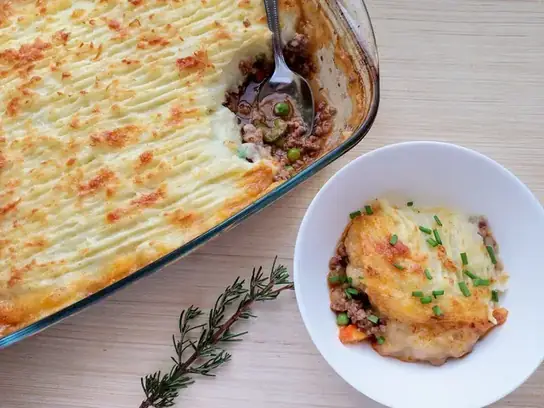
- Heat the oven to 200°C conventional / 180°C fan / Gas Mark 6. Spoon the hot filling into the oven dish, spread the mash over it, seal the mash to the edges, and ridge the top with a fork.
- Bake for 25 to 30 minutes, until the top is golden and the filling bubbles at the edges. Check the centre is piping hot — a probe should read at least 75°C, or steam should rise from the middle when you push a spoon in.
- Rest the pie for 5 to 10 minutes before serving, so the filling settles and holds its shape on the plate.
Judging the filling is straightforward. The mince should be tender enough to break apart with a spoon, the carrots soft, and the separate flavours settled into one gravy. The long cook is forgiving — an extra hour on Low (estimate) rarely harms a filling like this — but it is not endless, so assemble the pie reasonably soon after the filling is ready.
| Stage | Where | Time |
|---|---|---|
| Browning the mince and softening the vegetables | Hob | Part of the usual preparation, about 15–20 minutes |
| Filling cooks | Slow cooker | Low: about 6–7 hours · High: about 3–4 hours (estimates) |
| Mash made fresh | Hob | About 20 minutes, near the end of the cook (estimate) |
| Oven finish | Oven | 25–30 minutes (the tested recipe's bake) |
| Resting | Worktop | 5–10 minutes (the tested recipe's rest) |
Keeping it safe
Once the cooker is switched on, leave the lid on and the cooking undisturbed. Every lift of the lid lets out heat the cooker is slow to replace, and the food spends longer at lukewarm temperatures.
Defrost before cooking, too. Frozen mince should be defrosted in the fridge and fully thawed before it is browned for this recipe. A slow cooker warms food too slowly to thaw frozen ingredients safely — one more reason this method starts at the hob.
Never reheat food in a slow cooker. It warms too gently, and leftovers can linger in the temperature range where bacteria thrive. Reheat in the oven or the microwave instead, only once, until steaming hot all the way through.
Leftovers follow the usual rules. Cool the pie quickly, refrigerate it within 1 to 2 hours, and keep the fridge between 0 and 5°C. Eat leftovers within 2 days. The full guidance is in our FAQs, following Food Standards Agency advice.
A shorter version, and the tested original
The variations page carries a shorter slow cooker section if you want the outline without the detail. And if time is not the problem, the original cottage pie recipe — the kitchen-tested one — cooks the same filling on the hob in a fraction of the time.
Questions people ask
Not in this adaptation — browning is part of the method, not an optional extra. Raw mince cooked straight in the cooker steams in its own juices, so the flavour stays flat and the texture turns spongy. You also lose the chance to pour off excess fat, which leaves the gravy greasy. Fifteen minutes at the hob is what makes the long cook worthwhile.
You can, and the mash will cook through — but it will not brown, crisp or dry out. It stays pale and soft, and it can turn soggy as it absorbs liquid from the filling. That is precisely why this recipe tops the pie in a dish and finishes it in the oven.
Because the cooker traps nearly all its liquid, while an uncovered pan loses some as steam. This adaptation already cuts the stock to 300ml. If the filling is still thin, simmer it briefly in a saucepan on the hob to reduce it, or stir in a cornflour slurry — a teaspoon of cornflour mixed with a little cold water — and heat until the gravy thickens.
Follow your own cooker's instructions for its Warm setting, including any time limit the maker states. Treat Warm as a short holding stage for food that is already fully cooked — never as storage, and never as a way to cook or reheat. Once the meal is over, cool leftovers and refrigerate them within 1 to 2 hours, as with any cooked dish.
Yes. Freeze the cooled filling on its own, or freeze the assembled pie before or after its oven finish. Defrost in the fridge, then reheat once until steaming hot throughout — in the oven or microwave, never in the slow cooker. Our guide to freezing cottage pie covers containers, timings and defrosting in full.
The slow cooker does the waiting; the oven does the finishing. If you would rather cook the whole dish in one go, the kitchen-tested cottage pie recipe is the place to start.