
Air Fryer Cottage Pie: Dish Size, Method and Cooking Checks
By Michael
An air fryer can finish a cottage pie beautifully — golden ridges, bubbling edges — but it asks two questions first. Will the dish fit, and how will you know the centre is hot? Answer those, and the rest is the pie you already know.
This method adapts our cottage pie recipe, which serves four and was kitchen-tested in the oven. The air fryer version has not been kitchen-tested separately, so treat every time here as an estimate and judge the finished pie by the checks below, not by the clock alone.
First problem: the dish has to fit
The tested recipe fills a dish of about 2.5 to 3 litres, roughly 20 × 30 cm. That dish will not fit most air fryers. A drawer may look wide enough, but a dish that wedges in tightly blocks the moving air the machine cooks with, and the pie heats unevenly.
So measure before you cook anything. Measure the inside of the drawer or basket, across and diagonally, and check the height as well. Your dish needs clearance on every side — a centimetre or more — so the hot air can circulate around it. A dish that scrapes the sides is too big, whatever its label says.
The practical route for most machines is a half batch: the cottage pie for two, in a dish of about 1.2 to 1.5 litres. That size sits comfortably in a standard drawer with room around it, and the filling sits at much the same depth as the full pie.
Use this table as guidance only. Models vary widely, even between machines of the same stated size, and your own measurements come first.
| Air fryer | Dish that usually fits | Servings |
|---|---|---|
| Compact single drawer | Ramekins, or one small dish up to about 15 cm across | 1–2 |
| Standard single drawer | A dish about 18 to 20 cm across, about 1.2 to 1.5 litres | 2 |
| Large dual drawer or oven-style | A 20 × 30 cm dish may fit one wide drawer or shelf — measure first | Up to 4 |
Individual ramekins are the other good option. Four small pots can spread across a drawer or shelf where one large dish cannot, and small portions heat through more quickly. Oven-style machines with shelves are the main exception to the size problem: some take the full dish. The rule does not change — measure the space first, then choose the batch size to match it.
The filling is cooked on the hob first
This needs saying plainly: an air fryer does not make the filling. It bakes an assembled pie. Raw beef mince sitting in cold stock inside a drawer will not brown, and mince that has never browned, in thin gravy, is not cottage pie filling.
Make the filling exactly as the main recipe directs. Heat 1 tbsp of oil and brown the beef mince in a hot pan. Soften the onion, carrot and celery, then add the garlic, plain flour and tomato purée. Pour in the hot beef stock, add the thyme and bay leaf, and simmer until the gravy coats the back of a spoon. Stir in the frozen peas at the end.
Make the mash in a saucepan in the usual way too — floury potatoes, butter and warm milk. The air fryer's only job is the final stage: heating the assembled pie through and crisping its top. Everything before that happens on the hob, exactly as it does for the oven version.
Assembling the pie
Spoon the filling into your dish while it is still hot. Starting hot matters more here than it does in an oven. The air fryer stage is short, and a cold centre may never catch up with the browning top above it.
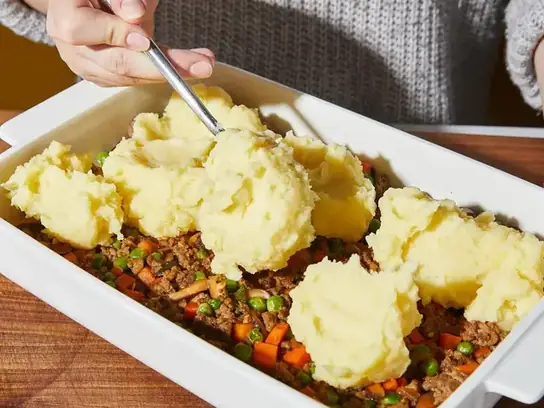
Spread the mash over the hot filling and seal it to the edges of the dish. Ridge the surface with a fork. The seal keeps the gravy from bubbling up the sides, and the ridges are the part that turns crisp and golden. If you like cheese on top, scatter it now — our variations page covers the cheese-topped version.
Cooking: temperature and time
Set the air fryer to 180°C. That is an air fryer setting, not an oven temperature: air fryers drive heat hard at the surface, so the oven's 200°C is not the figure to copy. A few minutes of preheating, if your model offers it, helps the top start crisping straight away.
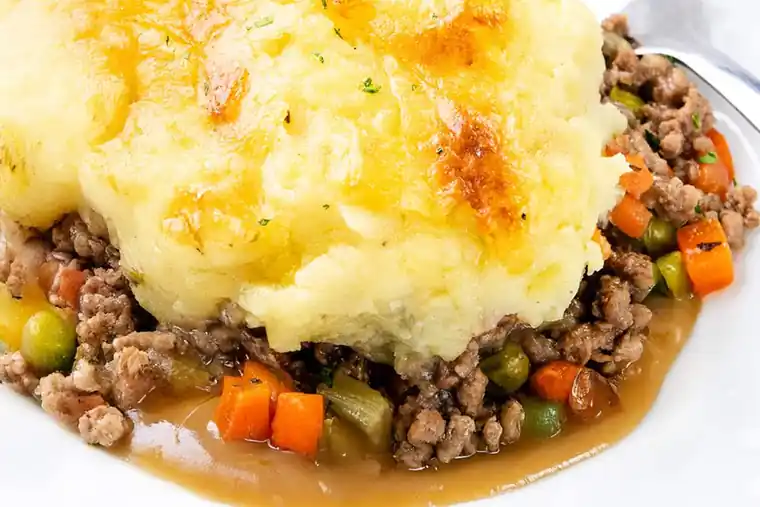
Cook for roughly 15 to 20 minutes from a hot filling. That range is an estimate, not a tested time. You are looking for a golden, crisped top with the filling bubbling up at the edges. Ramekins and shallow dishes sit at the short end of the range; a full two-person dish sits at the longer end.
If the top is browning faster than you want, cover the dish loosely with foil for the first part of the cooking and take it off for the last few minutes. Tuck the foil firmly down around the dish so the fan cannot lift it towards the element, and follow your appliance's own guidance on using foil.
The centre check: the step that matters most
Here is the air fryer's trap. It heats from above, so the mash colours quickly and the pie looks finished. The centre of the filling, underneath that mash, heats far more slowly. A golden top is not evidence of a hot middle, and serving on colour alone is how a cool centre reaches the table.
Check the centre every time. Push a food probe into the middle of the pie: it should read at least 75°C. If you have no probe, cut into the centre and look — the filling should be steaming, with the gravy bubbling, piping hot right through.
If the top is done but the centre is short of temperature, give the pie a few more minutes and check again. Cover the top with foil, tucked down as described above, if it is darkening while you wait. A cold filling at the start makes this stage much harder, which is why the pie goes in hot from the hob.
Resting and serving
Take the dish out and rest the pie for about 5 minutes before serving. The filling settles, the gravy thickens slightly, and the pie holds together on the spoon instead of flooding the plate. Serve straight from the dish, carefully — it will be very hot.
Leftovers follow the same rules as the oven-baked pie. Cool them quickly, keep them in the fridge, and reheat once until steaming hot throughout. The storage times and fridge temperatures are set out in our FAQs, following Food Standards Agency guidance.
Questions people ask
Only in the largest machines. The full pie needs its 2.5 to 3 litre dish, plus clearance around it for air to move. Some dual-drawer and oven-style models can take that; most single drawers cannot. Measure the inside of your machine before deciding, and if the dish does not fit with room to spare, make the half batch instead.
Defrost them first, in the fridge, and then cook as above. A pie cooked from frozen is likely to brown on top while its centre is still cold, because the heat has so much further to travel. Defrosting first gives an even centre. Fridge times and defrosting rules are covered in our FAQs.
Because an air fryer heats from above. The mash sits closest to the element, so it colours — and can over-colour — before the heat has worked down into the filling. Starting with hot filling shortens the gap. Foil over the top, tucked down firmly, slows the browning while the centre catches up. Always judge by the centre check, not by colour.
Yes, and they suit air fryers well. Small portions heat through faster than one deep dish, and ramekins fit spaces a single dish cannot. The cooking time will be at the shorter end of the estimated range, but times vary between machines — check the centre of each pot before serving, exactly as you would with a full dish.
With care. A liner cuts the airflow under and around the dish, which can slow the cooking and soften the result. Loose foil is a further hazard: the fan can lift it towards the element. If you line the drawer, keep the liner flat and weighted down by the dish, leave room for air to circulate, and follow your appliance's own guidance first.
Measure the drawer, make the filling on the hob, check the centre — and the air fryer makes a very good cottage pie. Start with the kitchen-tested cottage pie recipe, and use the half-batch quantities in cottage pie for two for the size most machines handle.