
What Size Dish Do You Need for Cottage Pie?
By Michael
The dish is the one piece of equipment that quietly decides how a cottage pie turns out. Too small and it bubbles over; too large and the filling dries under a thin layer of mash. This guide uses the measurements from our kitchen-tested recipe to help you pick the right dish — and to measure the one you already own.
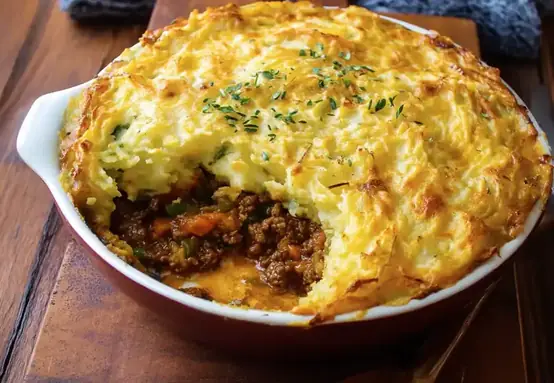
Why the dish size matters
A cottage pie is two layers in one dish, and the dish sets the thickness of both. The same filling and the same mash can bake into a deep, steaming pie or a thin, dried-out one, purely because of the dish they were spread across. Get the dish right and the tested timings in the cottage pie recipe — a bake of 25 to 30 minutes at 200°C conventional / 180°C fan / Gas Mark 6 — behave exactly as written.
There are two measurements to think about. The first is volume, in litres: how much the dish holds. The second is depth: how deep the food sits once it is in. Volume tells you whether the batch fits. Depth tells you how it will cook and eat.
The standard dish: about 2.5 to 3 litres
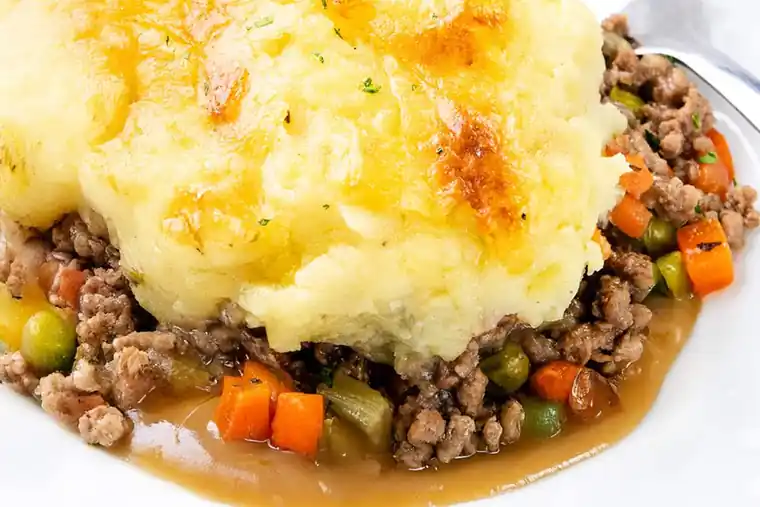
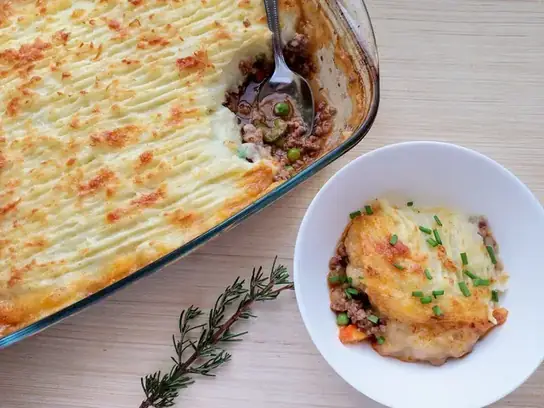
The tested recipe serves 4 and was cooked in a dish of about 2.5 to 3 litres, roughly 20 × 30 cm. That dish takes 500g of beef mince filling and 900g of potatoes as mash, and it is sized so the layers land where they should: the filling sits about 2.5 cm deep, the mash goes on top, and the finished pie stands about 4.5 to 5 cm deep.
That depth is the point. At 2.5 cm, the filling heats through evenly and stays moist without being soupy. The mash layer above it is thick enough to ridge with a fork, and those ridges are what crisp and catch the colour in the oven. There is also a little headroom left at the rim, which matters once the filling starts to bubble.
If your dish is a slightly different shape but a similar volume — a deep oval, a square dish, a round one — the pie will still work. It is the litres and the resulting depth that count, not the outline.
Too small: what goes wrong
Squeeze the standard batch into a dish well under 2.5 litres and three problems follow. First, the filling has nowhere to expand as it heats, so it bubbles up through the mash and spills over the rim onto the oven floor. Second, the mash layer ends up far too thick relative to the filling, so each serving is mostly potato. Third, a deep, crowded pie heats slowly at the centre: the top can be dark and crisp while the middle is still catching up.
The usual sign is a pie that looks done but serves wet and loose at the centre, with an oven shelf to clean afterwards. A baking tray under the dish catches the drips, but it does not fix the layer balance — the real fix is a bigger dish, or splitting the batch across two.
Too large: what goes wrong
Spread the same batch across a much bigger dish and the problems reverse. The filling lies in a thin layer, perhaps barely a centimetre deep, and a thin layer of gravy-rich filling dries out during the bake instead of staying succulent. The mash spreads thin too — too thin to ridge properly — so instead of crisp peaks you get a flat, pale sheet that can crack as it dries.
The pie also serves badly. Cottage pie should spoon out in a slab that holds its layers; a shallow pie collapses into a puddle on the plate. If your only dish is oversized, the honest options are to scale the recipe up to fill it, or to accept a thinner pie and check it earlier than the full bake, since a shallow pie heats through faster (estimate).
How to measure your own dish
Most dishes are not sold with their litre capacity printed anywhere useful, and guessing from the outside measurements misleads, because dishes taper and have thick bases. Measure it directly instead. It takes two minutes and you only ever do it once.
- Fill it with water. Put the dish in the sink and fill it to the brim with a measuring jug, a litre at a time, keeping count. The total is the dish's true capacity in litres.
- Mark the working level. A pie should not fill a dish to the brim — it needs headroom for bubbling. Roughly three-quarters of the brim capacity is the practical working volume.
- Check the depth. Stand a ruler upright inside the empty dish and note its internal depth. For the standard pie you want room for a finished depth of about 4.5 to 5 cm, plus a centimetre or so of headroom above the mash.
- Note it down. Write the litres on a label under the dish or in a notebook. Next time a recipe gives a dish size, you will know at a glance whether yours matches.
By that method, the standard dish for this recipe measures out at about 2.5 to 3 litres. If yours comes in anywhere in that range, use it with confidence and keep the tested timings exactly as they are.
Dish sizes by batch
| Version | Dish volume | Depth aim |
|---|---|---|
| For one | A small dish of roughly 0.6 to 0.75 litres (guidance) | Keep the same layer depths as the standard pie — filling about 2.5 cm, finished pie about 4.5 to 5 cm — in miniature. |
| For two | Roughly half the standard volume, about 1.25 to 1.5 litres (guidance) | Filling about 2.5 cm deep; finished pie about 4.5 to 5 cm deep. |
| Standard, serves 4 (tested) | About 2.5 to 3 litres, roughly 20 × 30 cm | Filling about 2.5 cm deep; finished pie about 4.5 to 5 cm deep, with headroom at the rim. |
| Double batch (serves 8) | One dish of about 5 to 6 litres — or two standard dishes | Two dishes keep the tested depth exactly. One big dish makes a deeper pie; keep the filling layer sensible and judge the longer bake by the centre, not the clock (estimate). |
The sizes for two and for one are guidance worked out from the tested dish, not separately tested dishes in their own right — the halved and quartered recipes themselves are set out in our guides to cottage pie for two and cottage pie for one. The principle that carries down is depth: a small pie in a small, deep dish eats like the original; a small pie spread across a big dish does not.
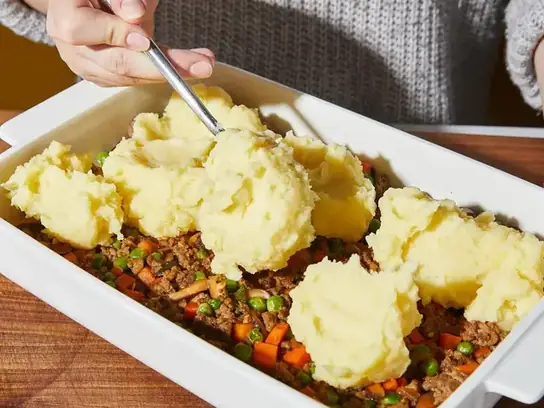
Round, rectangular, or whatever you own
Shape matters far less than volume. A round dish of about 24 to 26 cm across holds a similar volume to the rectangular 20 × 30 cm dish, as an approximation — check yours with the jug method if you want to be sure. Corners are the only real difference: a rectangular dish gives the mash four corners to seal into, while a round dish is a little easier to serve from. Neither changes the bake in any way worth adjusting for.
Material is a matter of general behaviour rather than rules. Ceramic holds heat and serves well at the table but warms up slowly. Metal heats quickly and is light to lift. Glass lets you see the filling bubbling at the sides, which is a genuinely useful doneness cue. All three bake this pie happily at the tested settings; if you swap between materials often, judge doneness by the bubbling filling and the colour of the top rather than by small timing changes.
Portions and small dishes
The same thinking scales down to leftovers and single servings. A portion reheats best in a small dish that fits it closely, with the layers at something like their original depth, rather than spread thin in a large one. Our batch-cooking guide covers portioning a double batch into containers for the fridge and freezer, which is the same principle: close-fitting, not cavernous.
Questions people ask
You can, but expect compromises: the filling is likely to bubble over the rim, the mash layer will be out of proportion, and the centre heats more slowly than the tested bake allows for. If a smaller dish is all you have, put a baking tray underneath and check the centre is bubbling and steaming before serving — and consider splitting the batch instead.
Yes, but the standard batch will spread thin and can dry out, with a mash layer too thin to ridge. Either scale the recipe up to fill the dish, or accept a shallower pie and check it earlier than the full 25 to 30 minutes, since a shallow pie heats through faster (estimate).
Fill it with water from a measuring jug, a litre at a time, and count. That gives you the true brim capacity. Treat about three-quarters of that as the working volume, since a pie needs headroom for the filling to bubble without spilling.
Yes. Volume and depth decide how the pie bakes, not the outline. A round dish of about 24 to 26 cm across holds a similar volume to a 20 × 30 cm rectangular dish, as an approximation — the jug test settles it for your own dish.
Either one dish of about 5 to 6 litres, or two standard dishes of about 2.5 to 3 litres each. Two dishes are the safer choice: each pie keeps the tested depth and the tested bake of 25 to 30 minutes. One big dish makes a deeper pie that needs a longer bake (estimate), judged by the centre check.
Only slightly, in general terms: ceramic warms slowly and holds heat, metal heats fast, and glass lets you watch the filling bubble at the sides. The tested settings — 200°C conventional / 180°C fan / Gas Mark 6 for 25 to 30 minutes — work across all three. Judge the pie by its bubbling centre and golden top rather than adjusting the clock.
Measure your dish once, and every version of this pie gets easier. Start from the cottage pie recipe, scale it with the for-two guide or the batch-cooking guide, and let the litres do the rest.